
Your website should welcome everyone — see how yours is doing. Scan your website for free here.
What Is Web Accessibility?
Web accessibility refers to designing and developing websites in a way that allows users of all abilities to access, navigate, understand, and engage with content and functionality.
Accessibility includes:
• Clear structure and semantic HTML
• Keyboard navigation support
• Alternative text for images
• Captions and accessible media
• Adequate contrast and readable typography
• Error guidance and form support
These practices align with WCAG success criteria and make websites compatible with screen readers, assistive technologies, and different forms of user interaction.
For people who are blind or have low vision, this is what makes the difference: with the right structure in place, your entire website can be navigated by sound. Screen readers like VoiceOver, JAWS, and NVDA read each page aloud, announce every button, link, and form field, and describe images through their alternative text — while braille displays and voice commands offer additional ways to browse. Our remediation work is what makes your site speak their language: we build the structure, labels, and descriptions those devices depend on.
Accessible Digital Experiences
Web accessibility means designing and developing websites so that people of all abilities — including visual, auditory, motor, and cognitive disabilities — can perceive, operate, understand, and engage with your content. A genuinely accessible site doesn't just satisfy a checkbox; it removes real-world barriers, improves usability for every visitor, and protects your business from a fast-growing area of litigation risk.
Under the Americans with Disabilities Act (ADA), public-facing businesses are increasingly held to the same accessibility standard online as in their physical premises. U.S. courts have repeatedly affirmed the Web Content Accessibility Guidelines (WCAG 2.1, Level AA) as the operative benchmark — and Los Angeles County leads California in ADA website lawsuit volume.
Why this matters: in April 2025 the Federal Trade Commission approved a final order requiring a leading vendor of AI "accessibility overlay" widgets to pay a $1 million penalty for deceptive claims that its product could make any website WCAG compliant. Businesses that rely on quick-fix overlays continue to face ADA lawsuits despite using them. Real remediation — semantic HTML, keyboard navigation, color contrast, accessible forms, ARIA labels — is the approach that meaningfully reduces that risk.
Source: FTC — final order: $1 million penalty for deceptive accessibility-widget claims (April 22, 2025) (opens in a new tab)
Accessibility Standards and Laws
WCAG
(Web Content Accessibility Guidelines)
WCAG is the international standard developed by the World Wide Web Consortium (W3C). It’s organized into three levels:
• A (minimum level)
• AA (recommended compliance)
• AAA (maximum accessibility)
Most organizations build toward WCAG Level AA, which balances accessibility with practical implementation.
How we get you there: we remediate your website so it works with the devices people with visual disabilities actually use — screen readers that navigate every page by sound, braille displays, voice control, and full keyboard-only navigation. Every image gets descriptive alternative text, every form gets a spoken label, and every page follows a logical structure an assistive device can announce clearly.
ADA
(Americans with Disabilities Act)
The ADA is a U.S. civil rights law that prohibits discrimination against individuals with disabilities. Although the ADA does not specify technical standards, courts and regulators frequently refer to WCAG as the benchmark for compliance.
Many public-facing businesses are expected to provide accessible websites as part of ADA obligations.
Failing to meet accessibility expectations can expose organizations to legal risk, including complaints and litigation.
Download Full PDF

Equal Access & User Inclusion
Accessibility ensures that every visitor — regardless of ability — can fully experience your website. That means people can understand your content, navigate and interact with every page, complete transactions without friction, access the services and information they came for, and use your forms and communication tools with confidence.
When these fundamentals are in place, you remove the digital barriers that quietly turn visitors away. The result is a site that works for people with permanent, temporary, and situational disabilities alike — and a brand that shows it genuinely values every customer. Inclusive design doesn't just serve a minority; it improves clarity, usability, and trust for everyone who visits, which often translates into stronger engagement and higher conversions.
Legal Risk Mitigation
In the U.S., ADA compliance — most often measured against the WCAG 2.1 AA standard — has become a real business concern, not a technicality. A website that falls short exposes your organization to accessibility litigation, regulatory complaints, costly financial penalties, and lasting reputation damage — often triggered by a single demand letter.
These cases have surged year over year, and businesses of every size are being named — including many that installed an overlay widget and assumed they were covered. Proactive remediation is the only reliable defense: by building genuine accessibility into your site, you reduce legal exposure, protect your revenue, and demonstrate the diligence that regulators and courts expect.
Our Web Accessibility Solution
Full Website Accessibility Audit & Structural Optimization
Every accessibility journey starts with a deep review of your existing website. This process examines your site’s structure, navigation flow, metadata, content hierarchy, and technical foundation to identify barriers that may affect users with disabilities and overall usability. Beyond visual elements, the audit evaluates semantic structure, headings, labels, alternative text, and how assistive technologies interpret your content. Necessary adjustments are then implemented to align with recognized accessibility standards such as WCAG, while also improving overall site performance and search engine clarity. The result is a stronger foundation that supports accessibility, usability, and better communication with search engines. And because accessibility is never a one-time fix, an intelligent AI layer keeps working after the remediation: it continuously scans your pages as content and features evolve, detects new barriers before they become problems, and keeps your site aligned with WCAG — while maintaining the clean structure and optimized metadata that search engines reward.
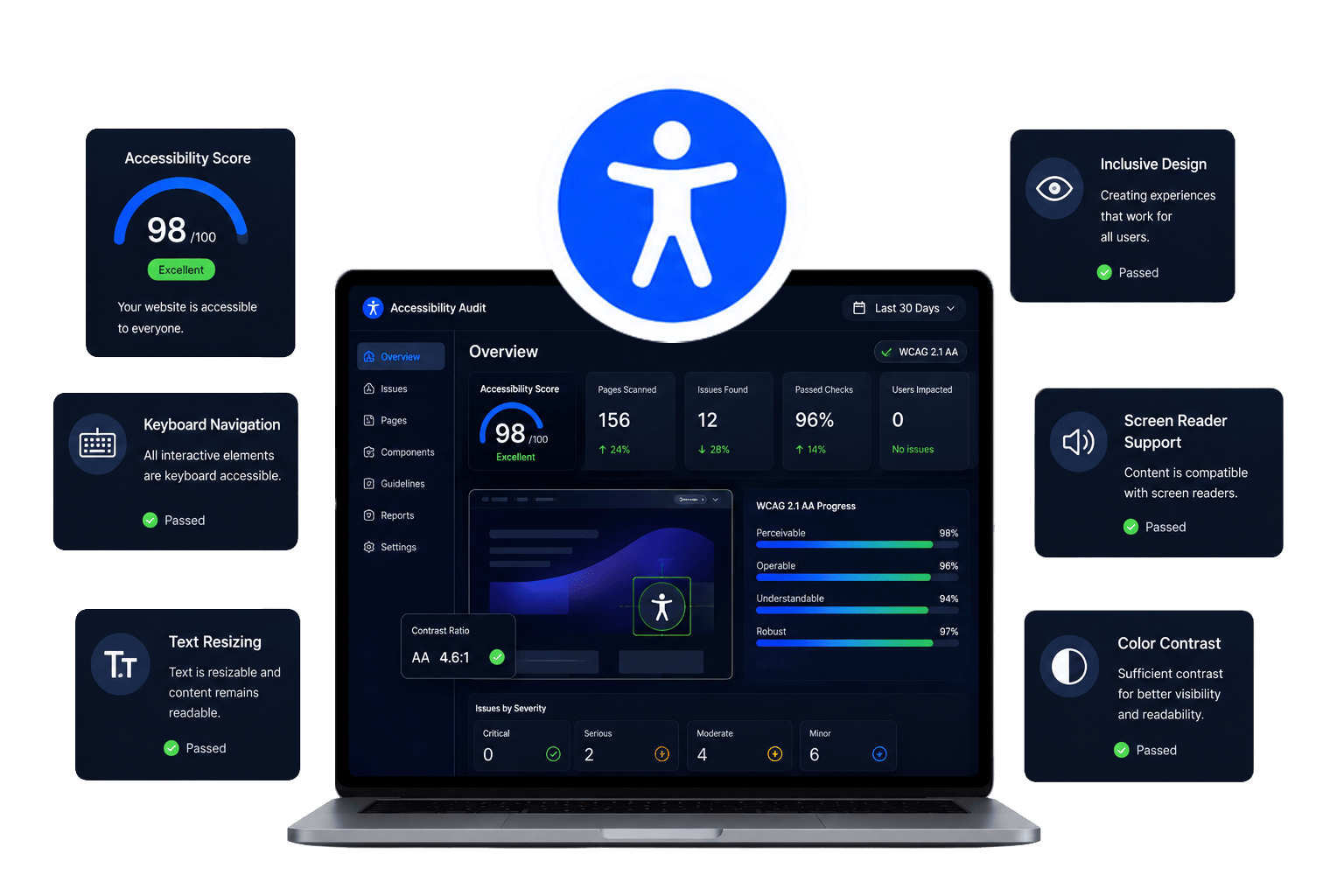

That intelligent layer is our own software: Veredia™ Assist, part of Veredia™ — the software line we build and maintain in-house at Indexia Digital™. And you don't have to imagine it: it is running on this very page. The accessibility panel at the bottom-right corner of your screen is Veredia™ Assist, live. Open it, make the text bigger, raise the contrast, turn on the reading guide — that is exactly how it works on your website.
Accessibility isn’t just ethical — it’s strategic.
Improved SEO and Usability Many accessibility practices — such as clear heading structures, meaningful alt text, and responsive design — also improve search engine optimization and usability for all users. Expanded Audience Reach By removing barriers, you open your site to more visitors, including people with permanent, temporary, or situational disabilities. Brand Trust and Reputation Accessible experiences communicate commitment to users. This fosters trust, strengthens brand identity, and differentiates your business from competitors.

Business Benefits of Accessibility
IRS Credit Up to 50% of Total Cost
Improving your website’s accessibility may not only create a more inclusive experience — it can also qualify your business for a federal tax credit of up to 50% of eligible accessibility expenses under IRS Form 8826 (Disabled Access Credit). This credit is designed to support small businesses in making accessibility improvements that help individuals with disabilities access services, information, and digital experiences more easily. Eligible expenses can include accessibility updates to your website, such as improving navigation, adding assistive features, enhancing usability, and meeting recognized accessibility standards. By investing in accessibility, businesses can reduce financial burden while building a more inclusive, compliant, and user-friendly online presence.
How the Credit Works
The Disabled Access Credit helps offset the cost of making your business more accessible. Qualified small businesses may claim a credit for a portion of eligible expenses related to accessibility improvements.
While tax credits depend on individual business circumstances, many website accessibility improvements can fall under qualifying expenses when properly documented.
Consulting a tax professional can help determine eligibility and ensure the correct use of IRS Form 8826 when filing. You can download the official forms directly from the IRS website using the button below.
Indexia Digital™ does not provide tax or legal advice, and we make no guarantee that your business will qualify — eligibility for this credit is determined solely by the IRS and your tax professional.
Download Tax Credit Forms (opens in a new tab)
Avoid Lawsuits
Demand Letters Are on the Rise
This is not a theoretical risk. In October 2019, the U.S. Supreme Court let stand a federal appeals-court ruling that the ADA applies to websites and apps, after Guillermo Robles — a blind customer — sued Domino's Pizza because its site and app didn't work with his screen reader. That decision opened the door to the wave of web accessibility litigation that followed.
The plaintiffs are organized, too: the Los Angeles Times reported in April 2026 that just seven serial plaintiffs filed roughly 1,000 ADA lawsuits across Southern California in 2025 — about 9,000 over the past decade — with business owners routinely paying five-figure settlements just to make a case go away. Most website cases start the same way: an automated scan finds barriers like missing alt text or broken keyboard navigation, and a demand letter arrives seeking thousands of dollars — money that doesn't fix the website.
Sources: CNBC — Supreme Court declines Domino's web accessibility case (Oct 7, 2019) (opens in a new tab) · Los Angeles Times — serial ADA lawsuits in Southern California (Apr 27, 2026) (opens in a new tab)
Real Compliance Is Your Best Defense
The most effective way to reduce this risk is to remove the barriers before a plaintiff finds them. That means a genuine audit against WCAG 2.1 AA, hands-on remediation of your site's structure, forms, navigation, and media — and documentation that shows the diligence courts and regulators expect from a responsible business. Indexia Digital™ handles the technical side end to end: we audit your website against WCAG 2.1 AA, fix what puts you at risk, monitor it as it evolves, and leave you with dated documentation of the work performed. If a demand letter ever arrives, you and your attorney respond with evidence of real, ongoing accessibility work — not scrambling to settle.
Contact Us Today
Indexia Digital™ is a web design and accessibility auditing company — not a law firm — and nothing on this page is legal advice. No accessibility work can guarantee that a claim will never be filed; what we provide is technical work on your website: audits, remediation, monitoring and documentation. For legal questions about the ADA, please consult your attorney.
Is Your Website Accessible to Everyone?

Scan your website for FREE
Enter your address and Veredia™ Scanner — our own auditing engine — will check it against the WCAG 2.1 criteria that software can verify, then tell you plainly what we found, and what only a person can catch.